
Zuranolone: A Novel Oral Treatment for Depression
How zuranolone works through GABA-A receptors, what its postpartum depression trials show, and what to know about a 14-day treatment course.
In this article
Zuranolone offers a different approach to treating depression: instead of targeting serotonin reuptake, it acts on the brain's inhibitory GABA-A signaling system. In the United States, it is approved as Zurzuvae for postpartum depression in adults. Its short treatment course and distinct mechanism make it an important option to understand—not a promise that one medicine will suit everyone.¹²
What is zuranolone?
Zuranolone is an oral neuroactive steroid. The FDA approved it in August 2023 as the first oral medication specifically indicated for postpartum depression (PPD). It can be used alone or alongside an oral antidepressant. That approval is for PPD—not a general approval for all forms of major depressive disorder.17
Its development followed research into allopregnanolone and the related treatment brexanolone. The important practical distinction is that zuranolone is taken orally rather than delivered as an IV infusion. Its clinical value rests on both the treatment evidence and the feasibility of using it safely at home.12
An in-depth look at its mechanism of action
The central idea is to strengthen inhibitory signaling through GABA-A receptors. ‘Inhibitory’ means making neuronal activity less likely to escalate—not switching the brain off. The following steps explain the pharmacology and why researchers became interested in this pathway for depression.23
A neuroactive steroid—not a serotonin reuptake inhibitor
Allopregnanolone is a naturally occurring neuroactive steroid derived from progesterone. It influences GABA-A receptor function. Zuranolone is a synthetic compound designed to act through this neurosteroid-sensitive system while being suitable for oral administration. Here, ‘steroid’ describes its chemical family; it does not mean an anabolic muscle-building steroid.238
This gives it a different primary target from an SSRI. It is not simply a faster version of the same serotonin-reuptake mechanism. Different targets expand the ways clinicians can approach depression, while the evidence for a particular condition still determines where a medicine fits.2
Positive allosteric modulation: helping GABA do its job
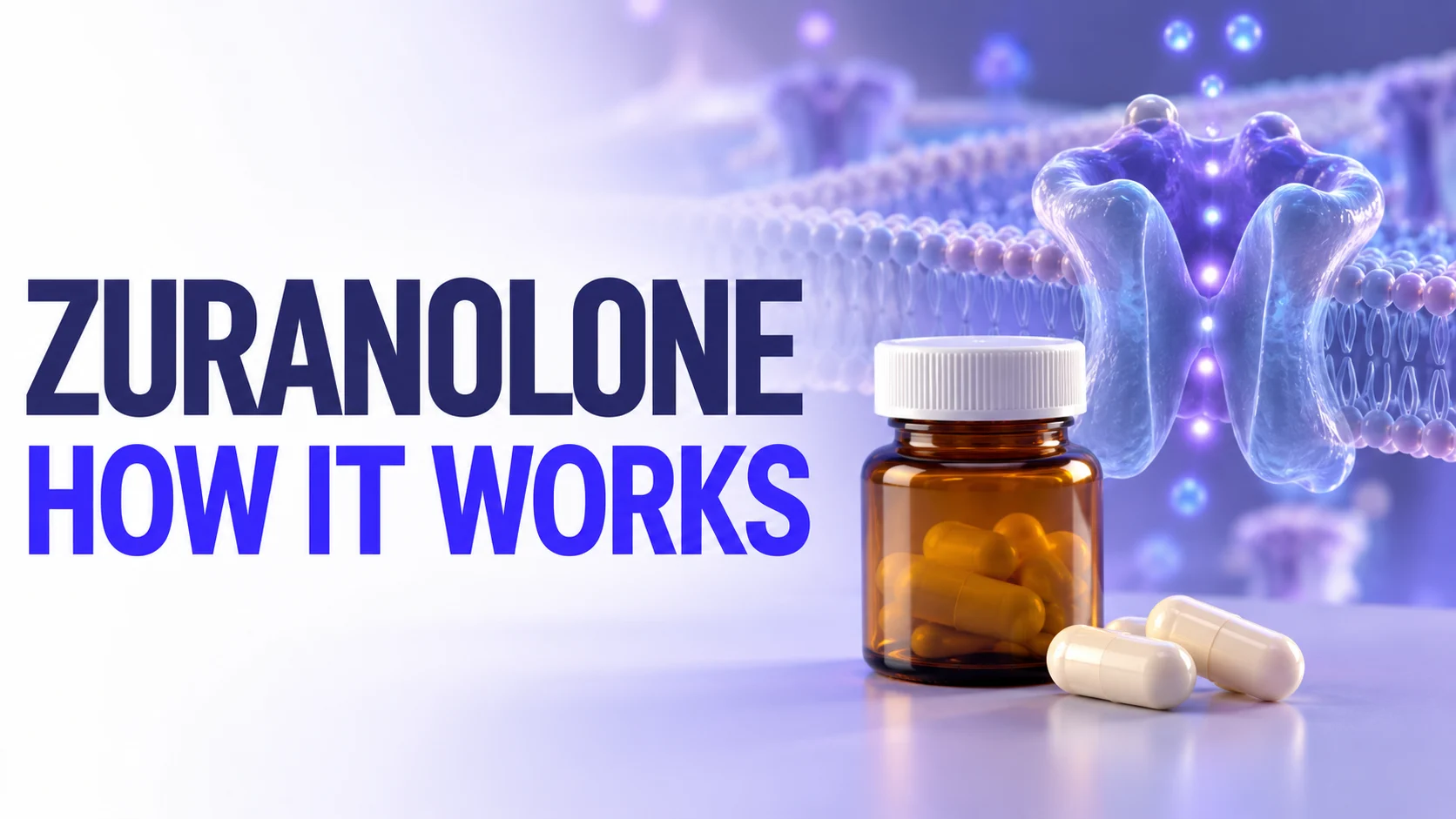
GABA-A receptors are ion channels activated by GABA, a major inhibitory neurotransmitter. Zuranolone acts as a positive allosteric modulator, or PAM: it binds at neurosteroid-sensitive sites distinct from GABA's binding site and enhances the receptor's response to GABA.28
When these channels open, chloride conductance increases. In mature neuronal circuits, that generally restrains excitability, making it harder for incoming signals to trigger firing. A useful analogy is reinforcing a braking system that is already present, rather than supplying a completely separate brake.8
Synaptic and extrasynaptic receptors: two layers of inhibition
Preclinical experiments show activity at receptor types associated with both synaptic and extrasynaptic signaling. Synaptic receptors help deliver brief, precisely timed inhibition—called phasic inhibition. Extrasynaptic receptors, outside the immediate synapse, help provide a more continuous background restraint called tonic inhibition.23
That distinction is part of what makes neuroactive-steroid pharmacology interesting. It offers a way to influence both moment-to-moment signaling and background excitability. It does not mean zuranolone is interchangeable with benzodiazepines simply because both affect GABA-A receptors.2
Why this matters after pregnancy—and what remains a working model
Pregnancy and delivery involve major changes in progesterone-derived neurosteroids. The brain's receptors adapt to those changes. Animal research has linked disrupted GABA-A receptor adaptation around pregnancy with postpartum depression-like behavior, helping establish a rationale for studying this pathway.3
That is a biological model, not a claim that every person with PPD has a measurable allopregnanolone deficiency. Zuranolone's receptor actions are better characterized than the complete chain from those actions to improved mood. The prescribing information describes the antidepressant mechanism as not fully understood, while identifying GABA-A modulation as the likely connection.37
The hopeful implication is practical: this pathway has produced an effective treatment option for PPD. It is not necessary to describe it as permanently ‘resetting’ the brain to recognize that contribution.14
What do the postpartum depression trials show?
In the phase 3 SKYLARK trial, a 14-day course of zuranolone 50 mg was compared with placebo in women with severe PPD. At day 15, the average reduction on the Hamilton Depression Rating Scale was 15.6 points with zuranolone versus 11.6 with placebo—a 4-point difference favoring zuranolone.4
Group differences were also reported at day 3 and at follow-ups through day 45. That is encouraging evidence for a relatively rapid effect and benefit extending beyond the dosing period. It does not establish that everyone improves within three days or that one course prevents all future episodes.4
A follow-up plan remains important: assess mood, functioning, safety, and any need for ongoing treatment rather than treating the last capsule as the end of care.4
What about depression outside the postpartum period?
Zuranolone has also been studied in major depressive disorder (MDD). In CORAL, it was started alongside a standard antidepressant and improved symptoms more than placebo plus an antidepressant at the day-3 primary endpoint. That early outcome is different from demonstrating lasting superiority at every later visit.5
Other findings have been mixed. The MOUNTAIN trial did not meet its primary day-15 endpoint for the 30 mg group. These studies remain relevant to understanding its potential, but research in MDD should not be presented as the same thing as its U.S. PPD indication.16
How is it taken?
The recommended regimen is 50 mg each evening for 14 days with fat-containing food. A prescriber may reduce it for tolerability or use a different dose because of interactions or kidney or liver impairment. Follow the prescription; do not repeat a course on your own.7
Side effects and practical safety planning
Sleepiness, dizziness, diarrhea, and fatigue can occur; confusion is a serious concern. Do not drive or do hazardous activities for at least 12 hours after each dose. Feeling alert does not reliably establish that driving is safe.17
Alcohol, opioids, benzodiazepines, and other sedating medicines can increase impairment. CYP3A4 interactions also matter, so have the prescriber or pharmacist review all medicines and supplements. Zuranolone is a Schedule IV controlled substance.7
Discuss pregnancy and breastfeeding. The label warns of fetal harm and advises effective contraception during treatment and for one week afterward. Milk levels are low, but infant effects are not established. Report worsening depression or suicidal thoughts promptly; seek emergency help if you cannot stay safe.17
The takeaway: a different pathway, a specific place in care
Zuranolone brings a neuroactive-steroid approach into PPD treatment, with a short oral course and evidence of relatively rapid benefit. Its GABA-A mechanism is an important part of the story, alongside the clinical results, safety planning, and support each person needs.124
If PPD is affecting you, asking about zuranolone can be one part of a broader conversation about treatment. Needing help does not reflect how much you love your baby or how hard you are trying.
By Birk Gundersen RN, BSN.
References
- FDA. FDA Approves First Oral Treatment for Postpartum Depression. August 4, 2023.
- Althaus AL, et al. Preclinical characterization of zuranolone (SAGE-217), a selective neuroactive steroid GABAA receptor positive allosteric modulator. Neuropharmacology. 2020;181:108333.
- Maguire J, Mody I. GABAA receptor plasticity during pregnancy: relevance to postpartum depression. Neuron. 2008;59:207–213.
- Deligiannidis KM, et al. Zuranolone for the Treatment of Postpartum Depression. American Journal of Psychiatry. 2023. SKYLARK randomized trial.
- Efficacy and safety of zuranolone co-initiated with an antidepressant in adults with major depressive disorder: results from the phase 3 CORAL study. Neuropsychopharmacology. 2024.
- Zuranolone in Major Depressive Disorder: Results From MOUNTAIN—A Phase 3, Multicenter, Double-Blind, Randomized, Placebo-Controlled Trial. Journal of Clinical Psychiatry. 2023.
- DailyMed. Zurzuvae (zuranolone) prescribing information: dosing, mechanism, warnings, interactions, pregnancy, and lactation.
- Majewska MD, et al. Steroid hormone metabolites are barbiturate-like modulators of the GABA receptor. Science. 1986;232:1004–1007. Foundational laboratory research on neuroactive steroids and chloride-channel signaling.

