
TMS for Depression: What to Expect from Treatment
A practical, evidence-aware guide to how transcranial magnetic stimulation works, what a treatment course can involve, and what to discuss with your care team.
In this article
When depression has not improved enough with medication or therapy—or when side effects make those options hard to continue—it can be discouraging to wonder what else is available. Transcranial magnetic stimulation (TMS) is a noninvasive, clinic-based treatment that offers another path for some people. It does not work for everyone, but research supports it as a meaningful option, and learning what treatment involves can make the next conversation feel more manageable.¹²
What is TMS?
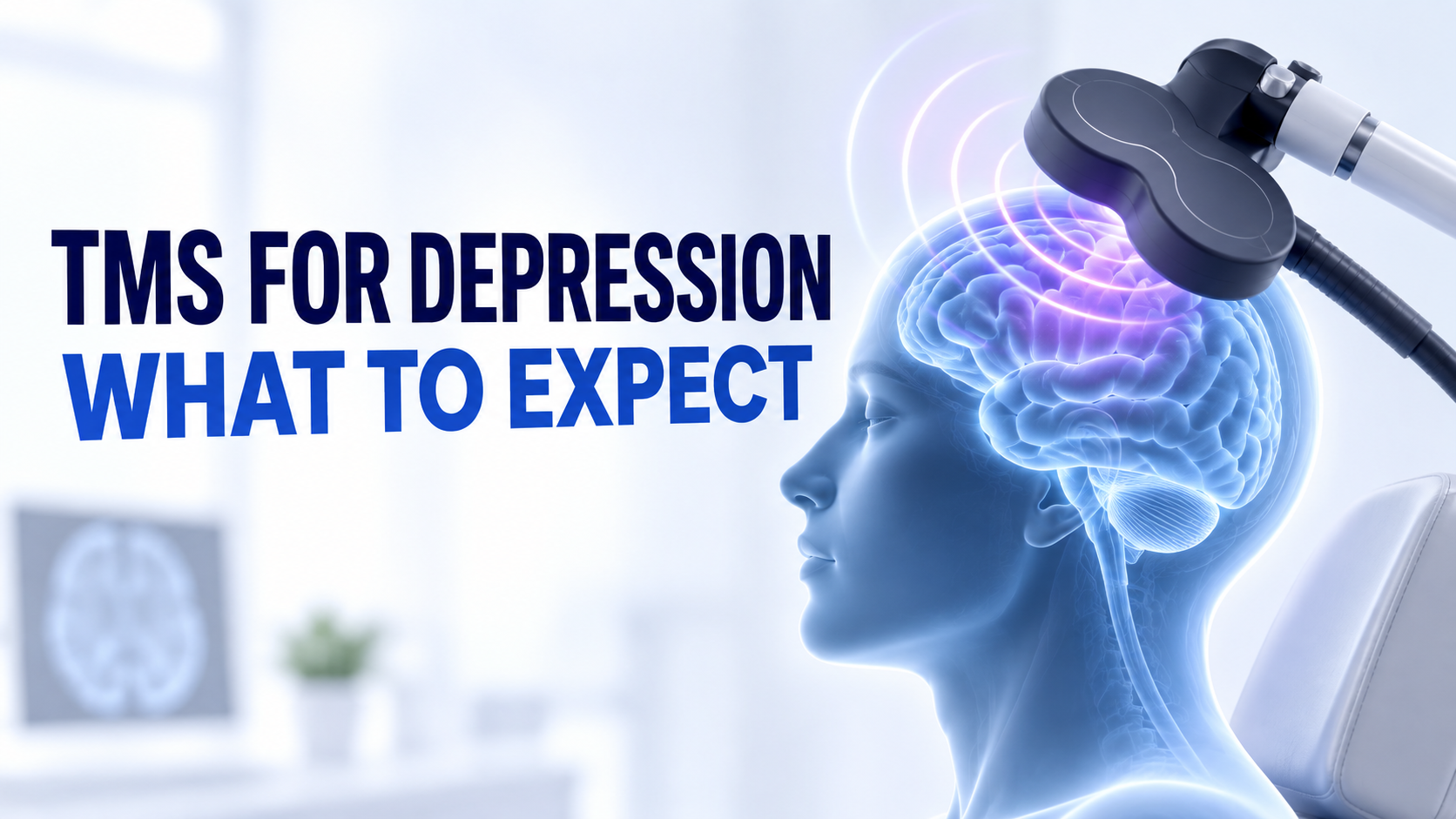
TMS uses a magnetic coil held against the scalp to deliver brief pulses that stimulate targeted brain circuits. For depression, clinicians commonly focus on areas of the prefrontal cortex involved in mood regulation. The treatment is noninvasive: there is no surgery, anesthesia, or medication delivered into the body. The exact biological effects are still being studied, but clinical research has established TMS as a treatment option for major depression.¹²
Different devices and protocols use different pulse patterns and treatment schedules. Some FDA-cleared devices also have other specific indications; that does not mean every TMS protocol is established for every mental-health condition. This article focuses on TMS for depression.¹
Who might consider it?
A clinician may bring up TMS when depression symptoms remain significant after trying one or more treatments, or when medication has not been a good fit. Exact eligibility depends on the device, clinical history, local practice, and sometimes insurance requirements. You do not have to wait until you have exhausted every possible treatment to ask whether a consultation makes sense.²⁴
TMS can be used on its own or alongside ongoing care, depending on the person’s plan. Your prescriber and TMS team can help weigh it against other options—such as adjusting medication, psychotherapy, or other forms of brain stimulation—based on your symptoms, preferences, health history, and how quickly support is needed.²
What happens during a course of treatment?
Before treatment, the clinic reviews your mental-health and medical history, medications, and any implants or metal near your head. The team identifies a stimulation location and intensity suited to you, explains hearing protection, and sets a plan for checking progress and side effects. Be specific about implanted devices or metal; whether TMS is safe depends on the device and its location, so the clinic needs to assess it rather than relying on a general rule.⁴
During a session, you sit awake in a treatment chair while the coil rests against your head. You may hear clicking and feel tapping or a brief pulling sensation. Many standard courses involve weekday visits for several weeks, although the length of each visit and overall schedule depend on the protocol. Some newer pulse patterns shorten the stimulation portion of a session; in the THREE-D trial, a three-minute theta-burst protocol performed similarly to the standard 10-Hz protocol for adults with treatment-resistant depression.³
People’s experiences differ. Some notice changes during the course; others need time after sessions or do not get enough benefit. The team can track symptoms with you and talk through next steps if improvement is limited. TMS is one option in a broader care plan, not a test you pass or fail.²
What does the evidence say?
The evidence for TMS in depression is substantial, including clinical trials and updated professional consensus guidance. In the THREE-D randomized trial, both standard repetitive TMS and intermittent theta-burst stimulation were associated with improved depression scores; the shorter theta-burst approach was found noninferior to the standard approach in the study population. This supports a faster session format, not a guarantee that TMS will help every person.²³
Researchers and clinicians continue to refine stimulation targets, schedules, and ways to match treatment to individuals. Some people improve meaningfully; some have partial improvement; and some do not respond. If it helps, your care team can discuss how to maintain progress and what to do if symptoms return.²
Benefits, side effects, and safety
Common side effects include scalp soreness or discomfort and headache, often around treatment sessions. Tapping can also cause temporary facial muscle twitching or lightheadedness. Hearing protection is used because the equipment makes a loud clicking sound. Let the team know if discomfort persists; the clinician may be able to adjust the setup or stimulation.⁴
A seizure is a rare but serious risk. TMS can also trigger mania in some people, particularly when bipolar disorder is present. Screening and supervision help the treatment team assess these risks. Tell them about a personal or family history of seizures, bipolar symptoms, neurologic conditions, medications and substances, sleep disruption, and any implanted or nearby metal or electronic device.⁴
TMS is different from electroconvulsive therapy (ECT): TMS is delivered while you are awake and does not intentionally induce a seizure. Neither treatment is automatically the right choice for everyone; a clinician can explain their different roles, benefits, and risks in your situation.²⁴
Questions to bring to a TMS consultation
- Which TMS protocol and device are you recommending, and what is the reason for that choice?
- What benefits are realistic for someone with my treatment history, and how will we measure whether it is helping?
- How many visits might I need, and what costs or insurance criteria should I check first?
- Do my medications, health history, or any implants or metal affect whether treatment is safe for me?
- Should I continue my current medication or therapy during treatment, and what is the plan if symptoms worsen or improve only partly?
A hopeful option—with a plan around it
Considering TMS does not mean you have run out of options or need to make a decision today. It can be a reasonable next conversation for people whose depression remains difficult to treat, and the evidence gives clinicians a solid basis for offering it to appropriate patients. A qualified treatment team can help you understand likely benefits, practical demands, safety considerations, and how TMS might fit alongside the supports you already have.²
Sources
- 1. FDA. Repetitive Transcranial Magnetic Stimulation Systems: Class II Special Controls Guidance
- 2. Consensus Review and Considerations on TMS to Treat Depression (2025)
- 3. Blumberger et al. THREE-D randomized noninferiority trial. The Lancet (2018)
- 4. Mayo Clinic. Transcranial magnetic stimulation: benefits, risks, and preparation

