
Challenging Assumptions: The Controversial World of Psychosurgery
From the history of lobotomy to rare, highly specialized neurosurgical procedures today: what psychosurgery means, where it may be considered, and why safeguards matter.
In this article
The word psychosurgery can bring to mind the lobotomy era—and for good reason. That history includes profound harms and serious failures of consent. Today, the term refers to a very small, specialized group of neurosurgical procedures considered only in exceptional circumstances. Understanding what has changed, what has not, and what safeguards are essential can help make a difficult subject clearer.
What does psychosurgery mean?
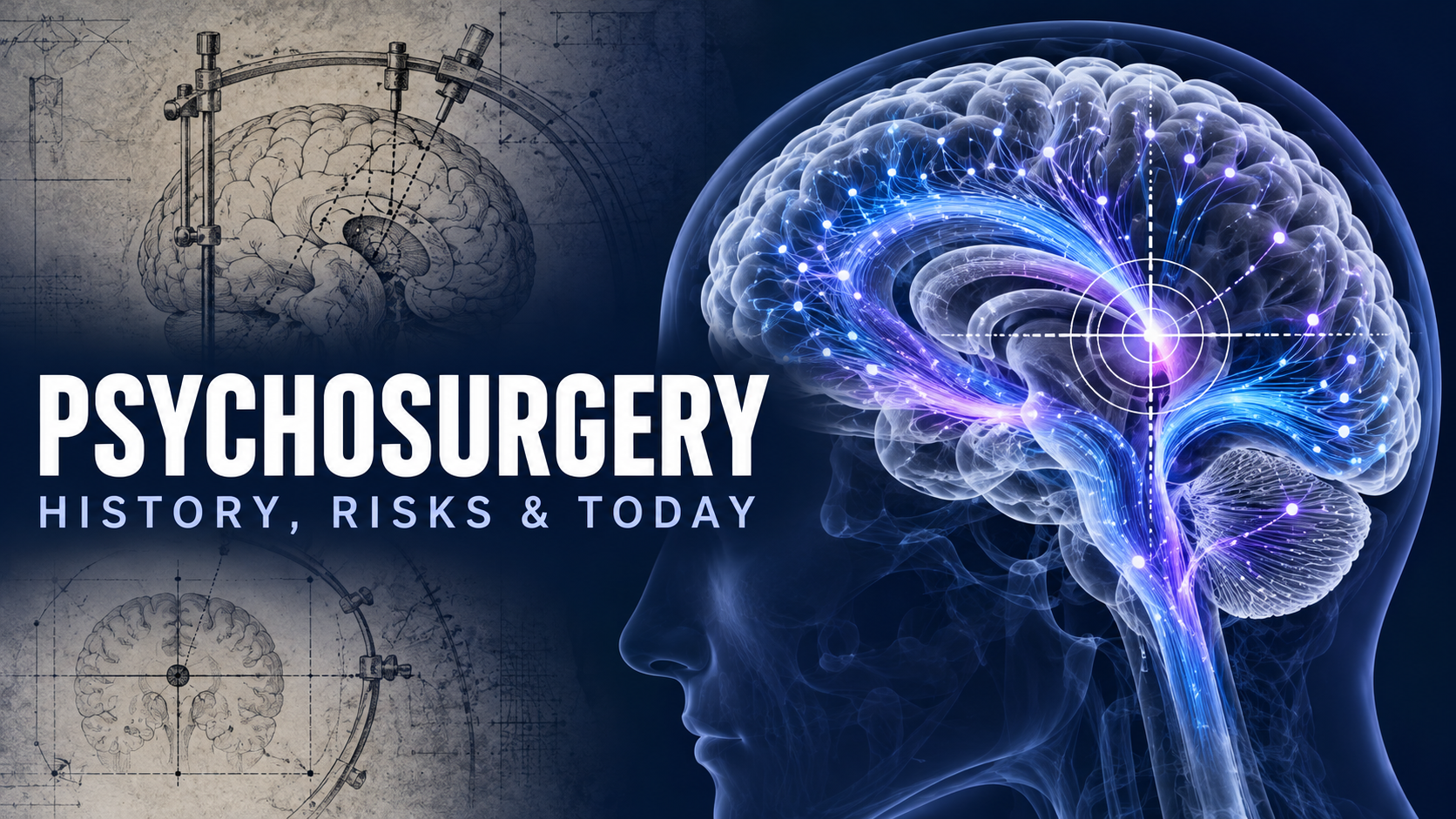
Psychosurgery, also called psychiatric or functional neurosurgery, refers to procedures that alter or influence brain circuits with the aim of relieving severe psychiatric symptoms. The term can cover different approaches: some operations make a small, intentional lesion in a targeted area, while deep brain stimulation (DBS) places electrodes that deliver adjustable electrical pulses. These procedures are not interchangeable, and DBS is not the same as removing or destroying brain tissue.¹²
Psychosurgery is also distinct from electroconvulsive therapy (ECT) and transcranial magnetic stimulation (TMS). Those are brain-stimulation treatments, but neither involves surgically cutting or implanting electrodes in the brain.³
A painful history—and why the term remains controversial
Modern psychosurgery took shape in the 1930s, when Portuguese neurologist António Egas Moniz introduced prefrontal leucotomy, later commonly called lobotomy. The procedure was adopted widely in some places before it was well understood. Many people experienced lasting changes in thinking, emotion, motivation, or independence; consent and oversight were often inadequate. Moniz received the 1949 Nobel Prize for his work, a reminder that scientific recognition does not erase the harms or ethical failures of a treatment’s history.⁴
The scale and consequences of lobotomy helped create enduring public mistrust. That history should be acknowledged directly—not treated as though modern techniques make the past irrelevant. It also explains why careful patient selection, independent review, informed consent, and long-term follow-up are central to any contemporary discussion.⁵
What is considered today?
Current psychiatric neurosurgery is uncommon and reserved for a narrow group of people with severe, disabling symptoms that have persisted despite substantial treatment. Depending on the condition and location, specialist teams may discuss a lesioning procedure or DBS. The evidence, availability, and regulatory status differ by procedure and diagnosis; there is no general-purpose brain operation for mental illness.¹²
For obsessive-compulsive disorder (OCD), deep brain stimulation has been studied for adults with chronic, severe, treatment-resistant illness. NICE guidance in the United Kingdom says it should be used only in the context of special arrangements for clinical governance, consent, and audit or research. In the United States, the FDA has permitted a specific DBS device for a narrowly defined OCD population through a Humanitarian Device Exemption; that is not the same as broad approval for psychiatric conditions.²⁶
DBS for depression remains an area of research rather than routine standard care. NIMH describes ongoing work to understand and personalize DBS for treatment-resistant depression; promising research is not the same as an established, widely available treatment.³⁷
Who might be evaluated—and what safeguards matter?
A person should not be considered for psychiatric neurosurgery simply because one medication or therapy has not helped. Expert consensus recommends a thorough review of diagnosis, previous treatment trials, medical and neuropsychological status, goals, expectations, and ability to give informed consent. A multidisciplinary team with relevant psychiatric and neurosurgical expertise should be involved, with appropriate independent oversight and follow-up.⁵
A careful evaluation also makes room for the person’s own priorities. The team should explain the realistic possibility of benefit, uncertainty, alternatives, and potential harms in language the person can use to make a voluntary decision. If a procedure is investigational, that status should be clear; participation in research should never be presented as a guaranteed route to improvement.⁵
Potential benefits and risks
For a small number of people with exceptionally severe, treatment-resistant symptoms, a targeted procedure may offer another avenue to consider when other options have not provided enough relief. Research and specialist experience suggest that some patients improve, but results vary, and the evidence base is limited compared with established treatments. It is reasonable to have hope while also asking for a clear account of what is known for the specific procedure and diagnosis.¹²⁵
Risks depend on the procedure. Brain surgery can involve bleeding, infection, seizures, or unintended effects on cognition, mood, behavior, or other functions. DBS also involves implanted hardware and ongoing programming and maintenance; stimulation effects may require adjustment, and complications can occur. Lesioning procedures intentionally create a permanent change, which makes careful weighing of benefits, alternatives, and irreversibility especially important.²⁵
Psychosurgery is not the only path forward
If symptoms remain severe after treatment, that does not mean a person has run out of options. A clinician can revisit the diagnosis, check for medical or practical barriers, and discuss other evidence-based approaches. Depending on the condition, these may include different psychotherapy, medication strategies, ECT, TMS, or other forms of specialist care. The right next step is individual, and most of these options do not involve brain surgery.³
Psychiatric neurosurgery is a serious and highly specialized topic—not a routine recommendation. Anyone exploring it should seek an independent opinion from clinicians experienced in the relevant condition and procedure, and should have time to ask questions and consider alternatives. Support and treatment options remain available even when the first approaches have not been enough.
Medical note
This article provides general education, not individualized medical advice. Decisions about psychiatric neurosurgery require evaluation by qualified specialists who know the person’s history, treatment course, preferences, and local regulatory context.
References
1. Fins JJ, et al. Consensus on guidelines for stereotactic neurosurgery for psychiatric disorders. https://pmc.ncbi.nlm.nih.gov/articles/PMC4145431/
2. NICE. Deep brain stimulation for chronic, severe, treatment-resistant obsessive-compulsive disorder in adults. https://www.nice.org.uk/guidance/ipg693
3. National Institute of Mental Health. Brain Stimulation Therapies. https://www.nimh.nih.gov/health/topics/brain-stimulation-therapies/brain-stimulation-therapies
4. Nobel Prize. Egas Moniz – Facts. https://www.nobelprize.org/laureate/348
5. Nuttin B, et al. Consensus on guidelines for stereotactic neurosurgery for psychiatric disorders. Journal of Neurology, Neurosurgery & Psychiatry. 2014. https://pubmed.ncbi.nlm.nih.gov/24444853/
6. U.S. Food and Drug Administration. Humanitarian Device Exemption: Reclaim DBS Therapy for OCD (H050003). https://www.accessdata.fda.gov/scripts/cdrh/cfdocs/cfhde/hde.cfm?id=H050003
7. National Institute of Mental Health. Personalizing Deep Brain Stimulation for Treatment-Resistant Depression. https://www.nimh.nih.gov/news/science-updates/2022/personalizing-deep-brain-stimulation-for-treatment-resistant-depression
Sources
- Consensus guidelines for stereotactic neurosurgery for psychiatric disorders
- NICE: Deep brain stimulation for treatment-resistant OCD
- NIMH: Brain Stimulation Therapies
- Nobel Prize: Egas Moniz
- FDA: Reclaim DBS Humanitarian Device Exemption H050003
- NIMH: Personalizing DBS for Treatment-Resistant Depression

