
Latest in Anxiety Treatment: Psychedelics, Neuromodulation
Introduction
In this article
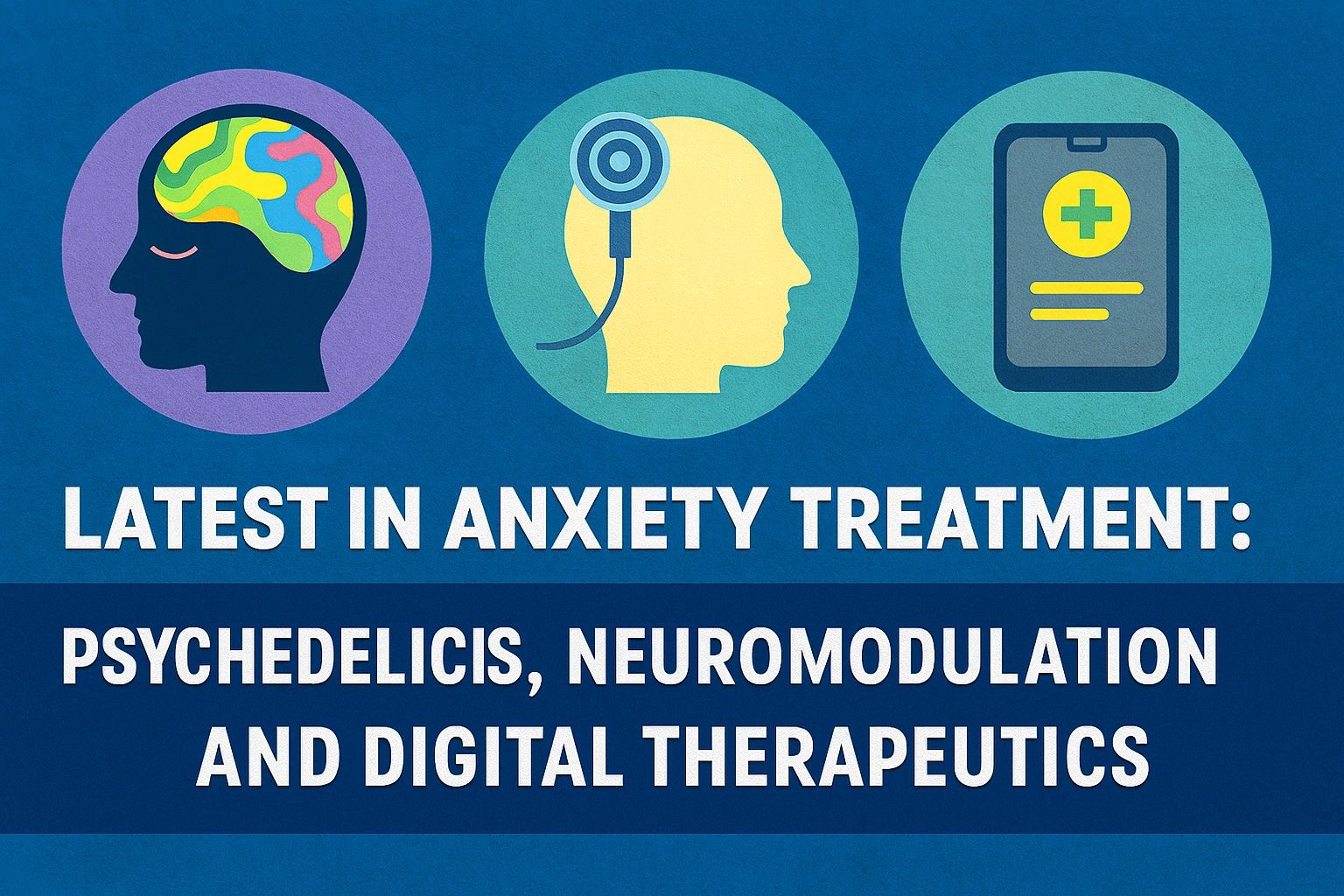
Anxiety disorders affect millions of people worldwide and often persist despite standard treatments. Selective serotonin‑reuptake inhibitors (SSRIs), serotonin–norepinephrine reuptake inhibitors (SNRIs) and psychotherapy remain first‑line therapies, yet many patients find relief to be slow or incomplete. This unmet need has sparked rapid research into novel pharmaceuticals and non‑pharmacological interventions. The past year brought several major developments – from psychedelic‑assisted therapies and rapid‑acting neuroactive drugs to neuromodulation and smartphone‑based digital therapeutics.
Introduction
Anxiety disorders affect millions of people worldwide and often persist despite standard treatments. Selective serotonin‑reuptake inhibitors (SSRIs), serotonin–norepinephrine reuptake inhibitors (SNRIs) and psychotherapy remain first‑line therapies, yet many patients find relief to be slow or incomplete. This unmet need has sparked rapid research into novel pharmaceuticals and non‑pharmacological interventions. The past year brought several major developments – from psychedelic‑assisted therapies and rapid‑acting neuroactive drugs to neuromodulation and smartphone‑based digital therapeutics.
LSD microdosing (MindMed MM120)
A phase‑2b trial of MM120 — a precisely dosed lysergic acid diethylamide (LSD) formulation — showed rapid and durable improvements in generalized anxiety disorder (GAD). In the study, a single 100 µg dose produced a 7.7‑point reduction in anxiety scores compared with placebo and achieved 65 % clinical response and 48 % remission by week 12. Participants’ Clinical Global Impression‑Severity scores improved from “markedly ill” to “borderline ill,” and benefits emerged as early as day 2 of treatment (Ferruggia, 2025). These compelling results led the U.S. FDA to grant MM120 breakthrough‑therapy designation and researchers are now conducting phase‑3 trials (Ferruggia, 2025).
An October 2025 report from the University of California San Francisco noted that MM120 alleviated anxiety by five to six points on a 56‑point scale, effectively re‑classifying moderate GAD as mild. Side‑effects such as hallucinations, nausea and headache were generally mild and more common at higher doses (Leigh, 2025). These findings fuel optimism that regulated LSD formulations could offer long‑lasting relief for treatment‑resistant anxiety (Leigh, 2025).
Ketamine‑assisted therapy
Ketamine, originally an anesthetic, has emerged as a rapid‑acting treatment for anxiety and depression. It promotes neuroplasticity and can reduce symptoms within hours or days. Clinical studies show ketamine significantly reduces symptoms of generalized anxiety disorder and treatment‑resistant anxiety (Strong, 2025). Treatment must occur under professional supervision because unsupervised compounded ketamine kits carry risks such as high blood pressure, dissociation and misuse (Strong, 2025).
MDMA‑assisted psychotherapy
MDMA (3,4‑methylenedioxymethamphetamine) is being investigated as a therapy for post‑traumatic stress disorder (PTSD) and social anxiety. Early trials suggest that MDMA‑assisted psychotherapy helps patients explore painful emotions by reducing fear and defensiveness. In a recent phase‑3 trial, MDMA‑assisted therapy significantly improved PTSD symptoms and functional impairment compared with placebo and had a high responder rate (Mitchell et al., 2023). However, MDMA therapy remains limited to clinical trials and is not yet FDA‑approved (Mitchell et al., 2023).
Emerging pharmacological agents
Beyond psychedelics, several novel molecules targeting non‑serotonergic pathways are in development. The most advanced candidate is BNC210 (soclenicant), a selective negative allosteric modulator of the α7‑nicotinic acetylcholine receptor. Early trials in social anxiety disorder demonstrated rapid anti‑anxiety effects without sedation or cognitive impairment (Kuntz, 2025). Other compounds, such as neurosteroid prodrugs and non‑hallucinogenic psychoplastogens, are in pre‑clinical development and may offer faster symptom relief with fewer side‑effects in the future.
Neuromodulation techniques
Non‑invasive brain stimulation offers drug‑free options for anxiety. Transcranial magnetic stimulation (TMS) uses magnetic pulses to modulate circuits in the dorsolateral prefrontal cortex. Although TMS is approved for depression, preliminary studies show it can reduce anxiety symptoms, with more than 70 % of participants responding and about one‑third achieving remission; improvements may last for at least three months (Allen, 2025). Sessions are individualized and require no sedation. Deep brain stimulation (DBS) involves surgically implanting electrodes to regulate specific circuits and is being explored for treatment‑resistant anxiety, particularly in cases co‑occurring with Parkinson’s disease or obsessive‑compulsive disorder; it remains experimental and reserved for severe cases.
Digital therapeutics
A major breakthrough in 2024 was the U.S. FDA clearance of DaylightRx, the first prescription digital therapeutic for GAD. DaylightRx delivers cognitive‑behavioral therapy via smartphone and, in a randomized controlled trial of 256 participants with moderate‑to‑severe GAD, produced remission rates exceeding 70 % and significantly reduced anxiety compared with a wait‑list control (Kuntz, 2024). Benefits persisted for six months and extended beyond anxiety to sleep, depressive symptoms and quality of life (Kuntz, 2024). Another digital therapeutic, SleepioRx, was cleared alongside DaylightRx to treat insomnia. According to the developer, Big Health, these digital mental‑health treatments have an average remission rate over 70 %, with nearly 500,000 people having used them (Big Health, 2024). Medicare reimbursement for digital therapeutics is expected to broaden access and adoption (Big Health, 2024).
Digital therapeutics address several barriers: high prevalence of anxiety and insomnia, suboptimal medication outcomes and growing demand for non‑drug options. Integration with telehealth services allows rapid access; for example, a large proportion of patients offered SleepioRx enrolled and experienced symptom improvement (Big Health, 2024).
Herbal and traditional medicine
Interest in herbal remedies persists, although evidence remains mixed. A 2025 narrative review of traditional Chinese medicine (TCM) noted that formulas such as Chaihu Shugan Sanand Suanzaoren Tang showed therapeutic potential for anxiety in small clinical trials. However, most studies suffered from small sample sizes, inconsistent outcome measures and lack of rigorous randomization, preventing firm conclusions (Wang et al., 2025). Standardization challenges — including variability in herb quality, dosing and diagnosis — further complicate clinical use. The authors called for well‑designed, multicenter randomized trials and integration of modern evaluation methods to establish safety and efficacy (Wang et al., 2025).
Off‑label medications
When first‑line treatments fail or cause intolerable side‑effects, clinicians sometimes prescribe medications off‑label — that is, for an indication not formally approved by regulators. Common off‑label options for anxiety include selective serotonin reuptake inhibitors (SSRIs) not formally approved for GAD (e.g., fluoxetine, sertraline, citalopram and fluvoxamine), tricyclic antidepressants (amitriptyline, imipramine and nortriptyline), beta‑blockers (atenolol and propranolol), monoamine oxidase inhibitors (phenelzine, isocarboxazid and tranylcypromine), antihistamines (hydroxyzine), anticonvulsants (gabapentin, pregabalin and valproate) and antipsychotics (olanzapine, aripiprazole and risperidone). These medications may provide relief for specific symptoms but should only be used under professional supervision because robust evidence for long‑term safety and efficacy is limited. Most are supported by small studies or clinical experience rather than large randomized trials, and they often carry significant side‑effect profiles (Pallanti et al., 2020).
Conclusion
The landscape of anxiety treatment is rapidly evolving. Psychedelic‑based therapies like MM120, ketamine and MDMA offer the promise of rapid, durable symptom reduction when delivered within controlled clinical settings. Emerging drugs such as BNC210 target novel mechanisms and aim to improve tolerability. Neuromodulation techniques like TMS and DBS provide drug‑free options, while FDA‑cleared digital therapeutics such as DaylightRx and SleepioRx extend evidence‑based therapy to smartphones and achieve high remission rates. Traditional herbal formulas remain of interest but require rigorous research before routine use. Off‑label medications offer flexibility when standard treatments fail but should be approached cautiously. Together, these innovations represent a shift toward personalized, multimodal approaches that prioritize rapid relief, neuroplasticity and patient preferences. As ongoing trials report results and regulators consider approvals, patients and clinicians may soon have a richer toolbox to manage anxiety effectively.
An abstract illustration of a human head surrounded by swirling blue patterns and soft light symbolizing anxiety and hope
References
Allen, M. (2025, August 11). Does TMS work for anxiety? Cognitive FX. https://www.cognitivefx.com/blog/tms-for-anxiety
Big Health. (2024, September 4). US FDA grants clearance for DaylightRx: The first prescription digital therapeutic for generalized anxiety disorder [Press release]. Big Health. https://www.bighealth.com
Ferruggia, K. (2025, September 9). Single-dose LSD therapy shows promise for generalized anxiety disorder. Pharmacy Times. https://www.pharmacytimes.com/view/single-dose-lsd-therapy-shows-promise-for-generalized-anxiety-disorder
Kuntz, L. (2024, September 5). First digital treatment for generalized anxiety disorder cleared by the FDA. Psychiatric Times. https://www.psychiatrictimes.com/view/first-digital-treatment-for-generalized-anxiety-disorder-cleared-by-the-fda
Kuntz, L. (2025). Target enrollment completed for phase 3 AFFIRM-1 trial of BNC-210 in social anxiety disorder. Psychiatric Times. https://www.psychiatrictimes.com
Leigh, S. (2025, October 7). Could this novel therapy calm anxiety for millions of Americans? University of California San Francisco. https://www.ucsf.edu/news/2025/10/430796/could-novel-therapy-calm-anxiety-millions-americans
Mitchell, J. M., Ot’alora, M. G., van der Kolk, B., Shannon, S., Bogenschutz, M., Gelfand, Y., … Yazar-Klosinski, B. (2023). MDMA-assisted therapy for moderate to severe PTSD: A randomized, placebo-controlled phase 3 trial. Nature Medicine, 29(10), 2473–2480. https://doi.org/10.1038/s41591-023-02565-4
Pallanti, S., Pittenger, C., Hollander, E., & Koran, L. M. (2020). Pharmacotherapy of anxiety disorders: Current and emerging treatment options. Frontiers in Psychiatry, 11, 595584. https://doi.org/10.3389/fpsyt.2020.595584
Strong, R. (2025, June 17). Ketamine therapy for anxiety: How it works, research, how to try it. Healthline. https://www.healthline.com/health/anxiety/ketamine-for-anxiety
Wang, Q., Wang, D., Lv, Y., & Li, Q. (2025). Traditional Chinese medicine in the management of anxiety disorders: A narrative review of theoretical foundations, clinical applications, and modern research evidence. Neuropsychiatric Disease and Treatment, 21, 1215–1233.
Words worth knowing
Cognitive behavioral therapy (CBT)
A structured therapy that helps people notice patterns between thoughts, feelings, and actions, then practice more helpful responses.
Neuroplasticity
The brain’s ability to change and adapt through learning, experience, and recovery.
Insomnia
A sleep disorder involving persistent difficulty falling asleep, staying asleep, or getting restorative sleep.

