
SSRIs Explained: What They Do, Where They Help, and What to Know Before Taking Them
SSRIs are among the most widely used mental-health medications. Their name describes one immediate action in the brain, but their benefits, limitations, and side effects are more complex than the familiar chemical-imbalance story suggests.
In this article
Selective serotonin reuptake inhibitors, usually shortened to SSRIs, transformed antidepressant treatment because they offered a useful balance: meaningful effectiveness for many people, fewer dangerous effects in overdose than older antidepressants, and side-effect profiles that are often easier to manage.
That does not make SSRIs simple drugs or the right choice for everyone. Some people experience substantial relief. Others feel little benefit, struggle with side effects, or need several attempts before finding a medication that fits. A realistic explanation of SSRIs should make room for all of those outcomes.
What Counts as an SSRI?
Common SSRIs include fluoxetine (Prozac), sertraline (Zoloft), escitalopram (Lexapro), citalopram (Celexa), paroxetine (Paxil), and fluvoxamine (Luvox). They share a primary target, but they are not interchangeable. Their approved uses, half-lives, interactions, activating or sedating qualities, withdrawal risk, and side-effect patterns differ.
How SSRIs Change Serotonin Signaling
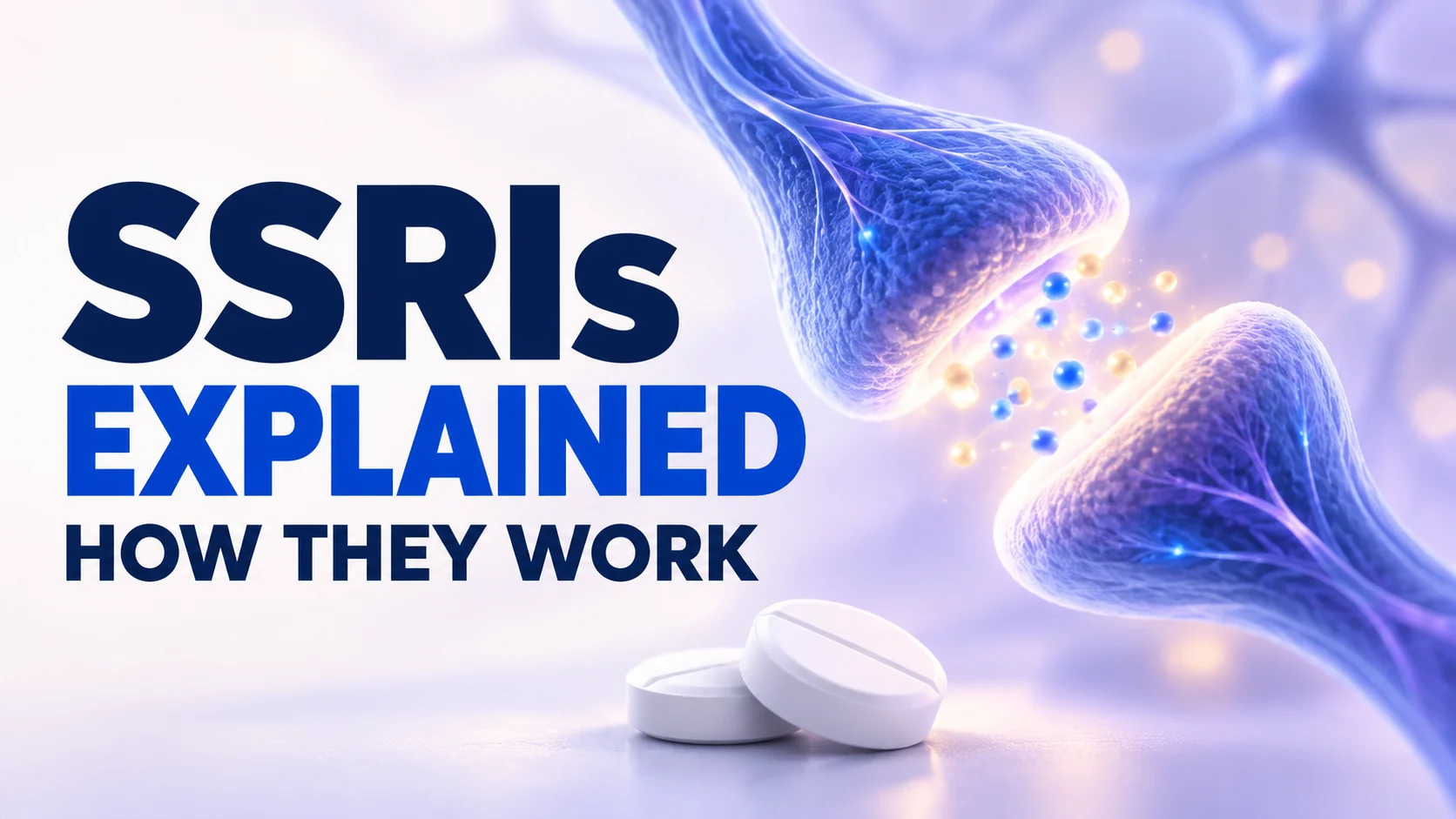
Serotonin is a chemical messenger involved in a wide range of functions, including mood regulation, threat processing, appetite, sleep, sexual function, pain, and digestion. When a serotonin-releasing neuron sends a signal, some serotonin enters the space between cells. A transporter called SERT normally carries much of it back into the releasing neuron.
SSRIs bind to that transporter and reduce reuptake. More serotonin therefore remains available in the synapse for a longer period. The drugs are called selective because their most prominent direct action is on serotonin transport rather than on several neurotransmitter systems at once, although each medication has its own secondary pharmacologic effects.
Why the Delay Matters
This transporter blockade begins quickly. Symptom relief usually does not. The National Institute of Mental Health notes that antidepressants commonly take four to eight weeks to work, and sleep, appetite, energy, or concentration may improve before mood does.[1]
The delay tells us that simply leaving more serotonin in a synapse is not the whole therapeutic mechanism. Current models focus on slower downstream changes: receptor adaptation, shifts in emotional processing, altered stress responses, gene expression, and neuroplasticity - the brain's ability to modify connections and learn new patterns.
One influential view is that SSRIs create conditions in which the brain becomes more able to relearn emotional expectations and respond differently to experience. A randomized human imaging study found evidence of increasing synaptic density after several weeks of escitalopram, supporting neuroplasticity as one plausible part of the delayed response.[2] The exact chain from serotonin-transporter blockade to recovery is still being investigated.
SSRIs can work without depression being caused by a simple serotonin shortage. The evidence does not support reducing depression to a single chemical deficiency.[3] A medication can still be effective even when the condition it treats has many biological, psychological, and social causes. Pain relievers can reduce pain without proving that pain is caused by a lack of that drug; antidepressant treatment does not require a one-chemical explanation either.
Where SSRIs Can Help
SSRIs are used for major depressive disorder and several anxiety-related conditions. Depending on the specific drug, FDA-approved indications may include panic disorder, social anxiety disorder, obsessive-compulsive disorder, post-traumatic stress disorder, premenstrual dysphoric disorder, and bulimia nervosa. Clinicians also use SSRIs off-label when evidence and individual circumstances support doing so.
For depression, large comparative analyses have found antidepressants more effective than placebo on average, while also showing that differences in efficacy and acceptability exist among individual drugs.[4] An average benefit does not guarantee an individual response, but it does establish SSRIs and other antidepressants as legitimate treatment options.
The benefit may show up as less despair, fewer intrusive fears, reduced compulsions, more emotional range, better ability to initiate tasks, or enough relief to participate more fully in therapy and daily life. The target is not artificial happiness. It is a reduction in symptoms that have narrowed a person's capacity to function.
Common Side Effects
Because serotonin signaling reaches far beyond mood, SSRIs can affect the digestive system, sleep, energy, and sexual function. Common effects include nausea or diarrhea, headache, sweating, tremor, fatigue or drowsiness, insomnia, restlessness or agitation, dizziness, dry mouth, appetite or weight changes, and sexual difficulties.[5]
Early nausea, headache, or jitteriness often improve. Sexual effects may persist and deserve attention. Depending on the person's priorities, a prescriber may adjust the dose or timing, switch medications, or consider another strategy.
Important Risks That Are Less Common
SSRIs are generally considered safer than older antidepressants, but they are not risk-free. Serotonin syndrome can occur when serotonin activity becomes dangerously high, most often through medication combinations. Symptoms may include agitation, confusion, fever, heavy sweating, diarrhea, muscle rigidity, tremor, or abnormal reflexes. Suspected serotonin syndrome requires urgent medical evaluation.
SSRIs can also increase bleeding risk, especially when combined with aspirin, nonsteroidal anti-inflammatory drugs, antiplatelet drugs, or anticoagulants. Hyponatremia, an abnormally low sodium level, is another uncommon but potentially serious effect, with greater concern in older adults and people taking diuretics. Drug-specific risks also matter, such as heart-rhythm concerns with higher citalopram exposure.
Mood and safety monitoring: Antidepressant labeling warns about increased suicidal thoughts and behaviors in children, adolescents, and young adults age 24 and younger during short-term studies. All patients should be monitored for sudden worsening, agitation, unusual behavior, or suicidal thinking, especially early in treatment and after dose changes.[6] New symptoms should be reported promptly. In the United States, call or text 988 for crisis support; call 911 or go to an emergency room when danger is immediate.
Prescribers also consider bipolar disorder before using an antidepressant. In someone vulnerable to mania or hypomania, an antidepressant can contribute to mood elevation, decreased need for sleep, impulsivity, or unusually accelerated thinking. Those changes require prompt clinical attention.
Stopping Is Not Always Simple
SSRIs are not considered addictive in the classic sense: they do not usually produce intoxication, craving, or compulsive drug-seeking. Physical adaptation can still occur. Abruptly stopping, missing doses, or reducing too quickly may produce withdrawal symptoms such as dizziness, electric-shock sensations, nausea, anxiety, irritability, vivid dreams, insomnia, flu-like feelings, or a return of emotional distress.
Withdrawal risk differs among drugs and people. Paroxetine is often more difficult to stop because it leaves the body relatively quickly, while fluoxetine's long half-life may make withdrawal less abrupt. Current NICE guidance recognizes that withdrawal can sometimes be severe or last weeks to months and recommends staged, individualized dose reduction with monitoring.[7] Tapering is not evidence of addiction; it is a response to neurobiological adaptation.
How SSRIs Compare With Other Antidepressants
SNRIs, such as venlafaxine, desvenlafaxine, and duloxetine, affect both serotonin and norepinephrine. They may be attractive when depression overlaps with certain chronic pain conditions or when a previous SSRI has not helped. They are not universally more effective, and some can raise blood pressure, increase sweating, or produce substantial withdrawal symptoms.
Atypical antidepressants differ widely. Bupropion may suit fatigue or sexual side effects, but it can be activating and is avoided with some seizure or eating-disorder risks. Mirtazapine may help insomnia or low appetite, though sedation and weight gain can limit it. Trazodone is often used for sleep; vortioxetine and vilazodone add serotonergic actions beyond reuptake inhibition.
Tricyclic antidepressants can be effective, particularly in selected depressive, pain, or headache conditions. Their anticholinergic effects, blood-pressure changes, cardiac risks, and greater toxicity in overdose often make them later-line choices. They are not automatically more effective simply because they affect more neurotransmitters.
MAOIs can be valuable for selected people, including some with difficult-to-treat or atypical depression. Their interaction burden is substantial: certain medications and high-tyramine foods can trigger dangerous reactions. They require an experienced prescriber and careful education, but they should not be dismissed when the clinical fit is strong.
Finding the Right Antidepressant
There is no universally best antidepressant. The useful question is which option offers the strongest match between likely benefit, tolerability, medical safety, and the person's own priorities.
A clinician may consider the condition being treated, symptom pattern, previous medication response, family history of response, sleep and appetite, sexual side effects, other medical conditions, pregnancy or breastfeeding, interactions, overdose safety, cost, and how difficult a medication may be to discontinue.
SSRIs are often a sensible starting point, but starting point does not mean final answer.
A first medication may work beautifully, help only partly, or fail. That outcome is information, not a personal failure. Careful follow-up makes it possible to adjust the dose, switch medications, combine treatment approaches, or reconsider the diagnosis and target symptoms.
Used thoughtfully, SSRIs can reduce suffering and restore room for relationships, work, therapy, creativity, and ordinary life. The most honest case for them is neither that they merely correct a chemical imbalance nor that their imperfections make them ineffective. They are complex tools that can be genuinely helpful when the medication, person, and treatment plan fit one another.
Sources
[1] National Institute of Mental Health. Mental Health Medications: onset, common effects, and medication selection.
[2] Knudsen GM, et al. Effects of Escitalopram on Synaptic Density in the Healthy Human Brain. Molecular Psychiatry. 2023.
[3] Moncrieff J, et al. The Serotonin Theory of Depression: A Systematic Umbrella Review. Molecular Psychiatry. 2023.
[4] Cipriani A, et al. Comparative Efficacy and Acceptability of 21 Antidepressant Drugs. The Lancet. 2018.
[5] U.S. Food and Drug Administration. Depression Medicines: SSRI effects, interactions, and safety information.
[6] U.S. Food and Drug Administration. Sertraline Prescribing Information: boxed warning, serotonin syndrome, bleeding, hyponatremia, and discontinuation.
[7] National Institute for Health and Care Excellence. Depression in Adults: Treatment and Management: safe withdrawal recommendations.
Words worth knowing
Neuroplasticity
The brain’s ability to change and adapt through learning, experience, and recovery.
Insomnia
A sleep disorder involving persistent difficulty falling asleep, staying asleep, or getting restorative sleep.

