
Guanfacine, Anxiety Treatment
What guanfacine is known to treat, what early research says about anxiety, and the safety points to review with a prescriber.
In this article
When anxiety feels tied to a body that stays on high alert, it is understandable to look for more options. Guanfacine affects a brain signaling system involved in attention and the body’s stress response. Researchers have explored whether that could matter for anxiety, but it is not an established anxiety treatment—and there are important, manageable safety points to know.
What guanfacine does
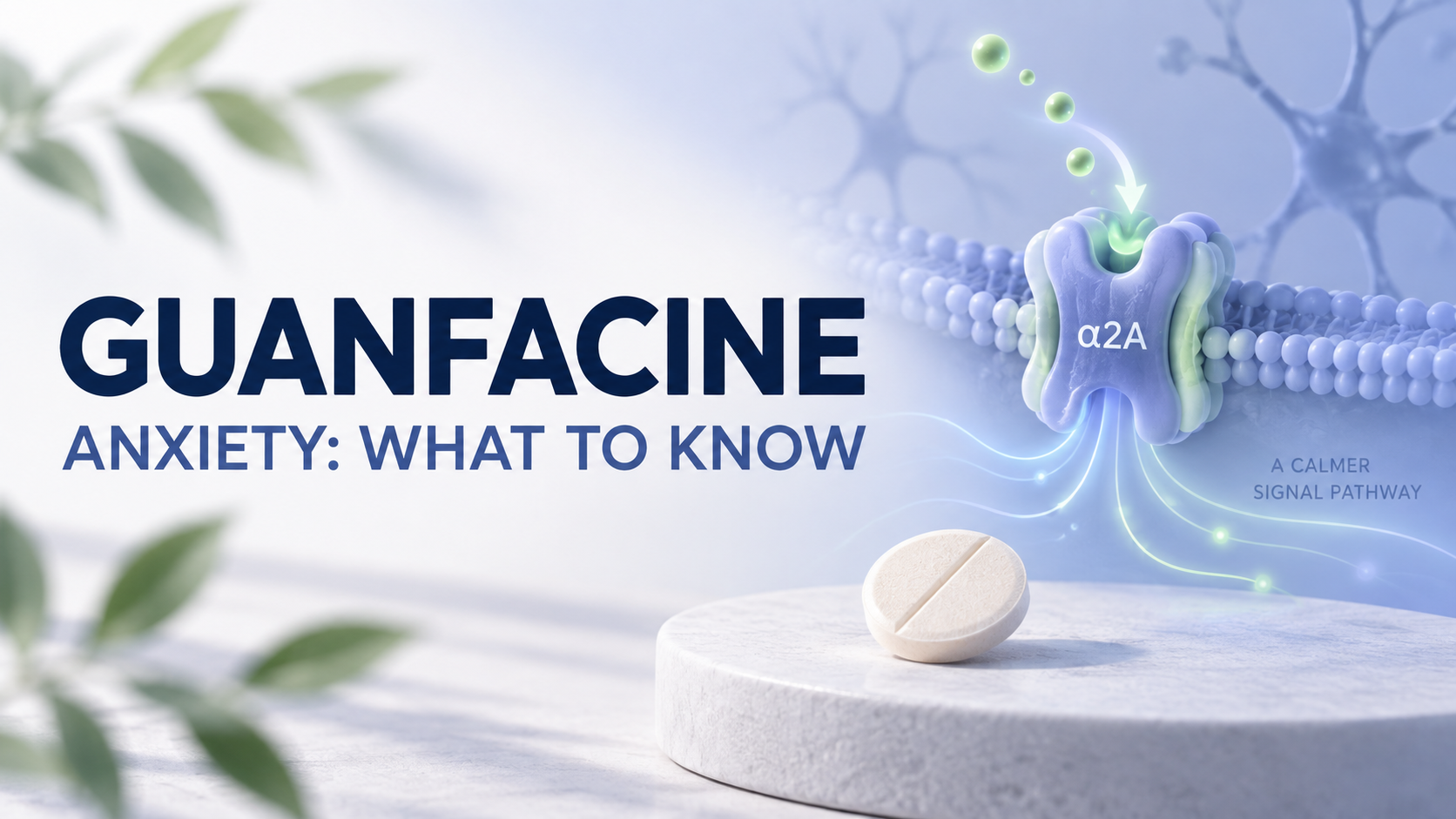
Guanfacine is a prescription medicine that stimulates alpha-2A adrenergic receptors in the central nervous system. The extended-release form is approved in the United States for attention-deficit/hyperactivity disorder (ADHD), alone or alongside stimulant medication. The immediate-release form is also used for high blood pressure. Anxiety disorders are not an FDA-approved indication.¹,²
By acting on these receptors, guanfacine can reduce some sympathetic nerve signaling and can affect blood pressure, heart rate, alertness, and attention. That biology gives researchers a reason to study it in conditions involving arousal or stress—but a plausible pathway alone cannot tell us whether it will relieve an anxiety disorder for a particular person.¹
What the anxiety research can—and cannot—tell us
There has been some early research. A small pilot randomized trial studied extended-release guanfacine in children and teens with several anxiety disorders. It was designed primarily to assess feasibility and safety, so its anxiety measures were exploratory: scores on two symptom scales did not differ from placebo, while clinicians’ overall ratings were numerically more favorable with guanfacine. The finding is an early signal to study further, not proof of reliable benefit.³
A review of guanfacine studies in young people with ADHD did not find a demonstrated effect on co-occurring anxiety symptoms, and a placebo-controlled trial in adults with post-traumatic stress disorder did not find guanfacine superior to placebo.⁴,⁵ These findings do not prove that no individual could benefit, but they do mean the evidence for treating anxiety itself remains limited and mixed.
If anxiety is affecting daily life, there are established options worth discussing, including evidence-based psychotherapy and medications selected for your symptoms and health history. In some cases a clinician may consider an off-label medication as one part of a broader plan, but guanfacine should not be treated as a proven replacement for standard anxiety care.
When a clinician might discuss it
A prescriber may consider guanfacine when there is another relevant treatment goal—such as ADHD symptoms—or when a person’s history makes a careful off-label discussion reasonable. The decision should be individualized: the clinician can weigh the quality of evidence for the concern being treated, other available approaches, prior treatment experiences, and possible effects on blood pressure, pulse, and alertness.
It can help to ask: What symptom are we targeting? What would count as meaningful improvement? How will we monitor blood pressure, pulse, and sleepiness? When will we review whether the plan is helping? Those questions keep the choice collaborative and make room for other options if it is not a good fit.
Formulations and taking it safely
Guanfacine comes in immediate-release and extended-release forms. They are absorbed differently and should not be substituted milligram-for-milligram. The appropriate formulation and schedule depend on why it is being used and on individual factors; anxiety does not have an established guanfacine dose. Follow the prescription label and your prescriber’s instructions rather than a dose listed online.¹
Tell your prescriber and pharmacist about all medicines and supplements you take. Some medicines can change guanfacine levels, and other medicines that lower blood pressure, slow the heart rate, or cause sedation may add to its effects.¹
Side effects and warning signs
Sleepiness, fatigue, dizziness, and low blood pressure are among the effects reported with extended-release guanfacine. It can also slow the heart rate; fainting and heart-conduction problems are less common but important risks. Until you know how it affects you, use caution with driving or other tasks that require alertness, and avoid alcohol or other sedating substances unless your clinician says otherwise.¹
Contact your care team if you develop troublesome dizziness, unusual weakness, a very slow pulse, or near-fainting. Seek urgent care for fainting, chest symptoms, or another severe or rapidly worsening reaction. Your own risk depends on your health history and other medicines.
Do not stop suddenly without guidance
Stopping extended-release guanfacine abruptly can cause a rise in blood pressure and heart rate, sometimes above the prior baseline. If you and your prescriber decide to stop, they can plan a gradual reduction and decide whether monitoring is needed. If you miss several doses or cannot keep medicine down, ask your care team how to restart safely rather than taking extra doses.¹
A hopeful, realistic takeaway
Guanfacine is a useful medication for some approved purposes, and its effects on arousal and attention have led researchers to explore other possibilities. For anxiety disorders, though, the research is still too limited to call it a well-established treatment. That leaves room for thoughtful, clinician-guided conversations without asking you to rely on a claim the evidence has not confirmed.
If you are curious about guanfacine, bring the question to a qualified prescriber. Together, you can compare the possible role of an off-label option with better-established treatments, review safety, and build a plan around what matters most to you.
References
- [1] DailyMed. Intuniv (guanfacine extended-release): U.S. prescribing information, revised June 2025.
- [2] DailyMed. Guanfacine immediate-release tablets: U.S. prescribing information.
- [3] Strawn JR, et al. Extended Release Guanfacine in Pediatric Anxiety Disorders: A Pilot, Randomized, Placebo-Controlled Trial (2017).
- [4] Van Stralen J. Effectiveness of guanfacine on comorbid disorders in children and adolescents with ADHD: a systematic literature review (2019).
- [5] Davis LL, et al. A placebo-controlled trial of guanfacine for the treatment of posttraumatic stress disorder in veterans (2008).

