
Revealing the Hidden Truth About Genetic Depression
How inherited vulnerability, life experiences, and biology can combine to shape depression risk—and why genes are not destiny.
In this article
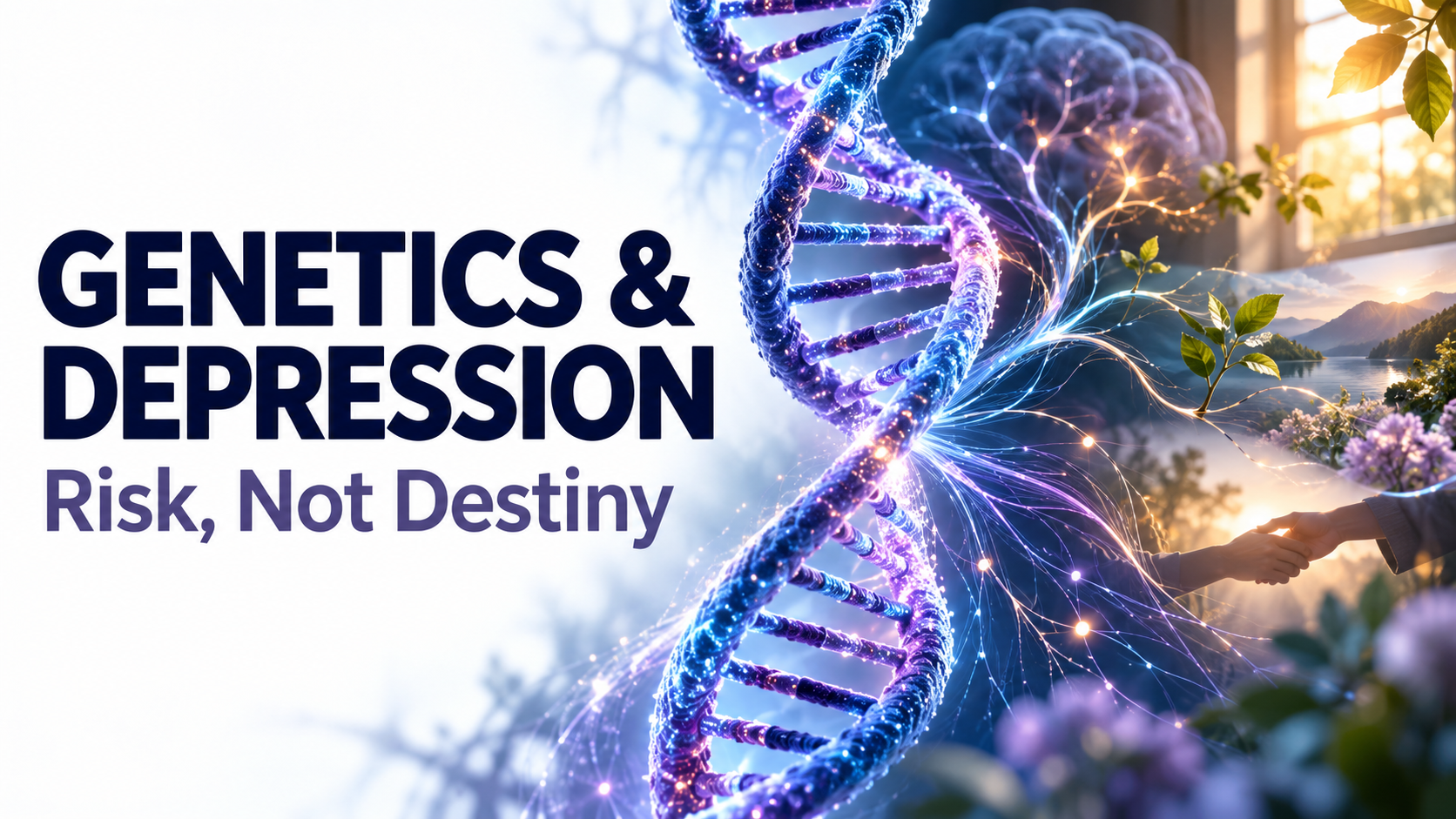
Depression can run in families, and that can raise a difficult question: Am I destined to experience it too? The evidence points to a more hopeful and more accurate answer. Genes can influence vulnerability, but they do not write a fixed script. Depression usually reflects many factors interacting over time—including biology, life experiences, health, and support—and there are effective ways to seek help.
What does genetic predisposition mean?
A genetic predisposition means that inherited differences may tilt a person’s odds of developing a condition. It is not the same as having a diagnosis, and it does not mean the outcome is inevitable. For major depressive disorder (MDD), there is no single “depression gene” that explains most cases. Researchers instead describe a complex, polygenic pattern: many genetic variants may each contribute a very small amount to risk, alongside non-genetic influences.¹²
Family history can be useful context. People with a parent or sibling who has experienced depression have a higher average risk than people without that history. But family members share more than DNA: they may also share circumstances, stressors, health habits, and sources of support. And family history is never a verdict—many people with depression have no known family history, while many people with an affected relative never develop depression.²
What genetics research has found
Twin and family studies suggest that inherited factors explain part of the variation in depression risk across a population. One large Swedish twin study estimated heritability at about 37%. That number does not mean that 37% of one person’s depression is genetic; heritability is a population-level estimate that depends on the groups and conditions studied. It describes patterns across people, not an individual’s future.⁴
Genome-wide association studies (GWAS) scan DNA across large groups to find variants that occur more often among people with a condition. A 2025 trans-ancestry study involving 688,808 people with major depression and more than 4.3 million comparison participants identified hundreds of associated genetic signals. This is an important step toward understanding the biology involved, but a statistical association is not a cause by itself, and the findings are not a personal prediction test.³
The results point to a broad biological landscape rather than one simple pathway. Variants can be involved in different processes, and depression itself includes many combinations of symptoms and life histories. As studies grow and include more diverse populations, researchers can learn more about which findings are shared and where patterns differ.³
How life experiences and biology interact
Genes are not working in isolation. Stressful or traumatic experiences, chronic illness or pain, disrupted sleep, social isolation, and other circumstances may affect mental health. Protective experiences—such as connection, stability, and timely care—also matter. These influences do not make depression a personal failing; they help explain why people with similar family histories can have very different lives and symptoms.¹²
Epigenetics is one area of research into how cells regulate gene activity without changing the underlying DNA sequence. Scientists are studying whether experiences and biological processes are related to these patterns in depression. The findings are complex and still developing, especially in human studies; they do not mean that a person can simply “switch off” inherited risk. For now, epigenetics offers a way to investigate how biology and environment may connect, not a clinical test or a proven treatment target.⁴
Can a genetic test tell me whether I will get depression?
At present, common genetic tests cannot accurately tell an individual whether they will develop depression. The many variants involved generally have small effects, and a result cannot account for all the experiences, health factors, and changes that shape someone’s life. Direct-to-consumer reports about mental-health risk may be difficult to interpret and should not be used to diagnose depression or make treatment decisions on their own.¹
If depression runs in your family, that history can still be worth sharing with a health professional. It may help you notice changes early and have a more informed conversation about symptoms, stress, and support. A genetic counselor or clinician can also explain when genetic testing is relevant for a specific inherited condition; that is different from predicting ordinary depression risk.¹²
Risk is not destiny—and support is available
A family history can be one clue, not a forecast. If you are experiencing persistent low mood, loss of interest, changes in sleep or appetite, low energy, or difficulty managing daily life, you do not need to wait for a genetic explanation before asking for help. A primary-care professional or mental-health clinician can assess what is going on and discuss options suited to your needs.⁵
Depression can be treated. Psychotherapy, medication, or a combination may help, and brain-stimulation therapies can be considered in some situations when other treatments have not helped enough. Finding a good fit sometimes takes adjustment, but a disappointing first step does not mean you are out of options. A clinician can help make a plan and revisit it with you as your needs change.⁵
The takeaway is not that genes control your future. Genetics is helping researchers understand depression’s many biological pathways, while each person’s story remains shaped by more than DNA. Whether or not depression runs in your family, care, connection, and practical support can make a meaningful difference.
Medical note
This article is for general education, not individualized diagnosis or treatment advice. If symptoms are affecting your life, talk with a qualified health professional. If you or someone you know may be in immediate danger or is thinking about suicide in the United States, call or text 988; call 911 for an immediate emergency.
Sources
- National Institute of Mental Health. Looking at My Genes: What Can They Tell Me About My Mental Health?
- MedlinePlus Genetics. Depression: Causes and Inheritance.
- Major Depressive Disorder Working Group of the Psychiatric Genomics Consortium. Trans-ancestry genome-wide study of depression identifies 697 associations implicating cell types and pharmacotherapies. Cell. 2025;188(3):640–652.e9.
- Penner-Goeke S, Binder EB. Epigenetics and depression. Dialogues in Clinical Neuroscience. 2019;21(4):397–405.
- National Institute of Mental Health. Depression. Revised 2024.

